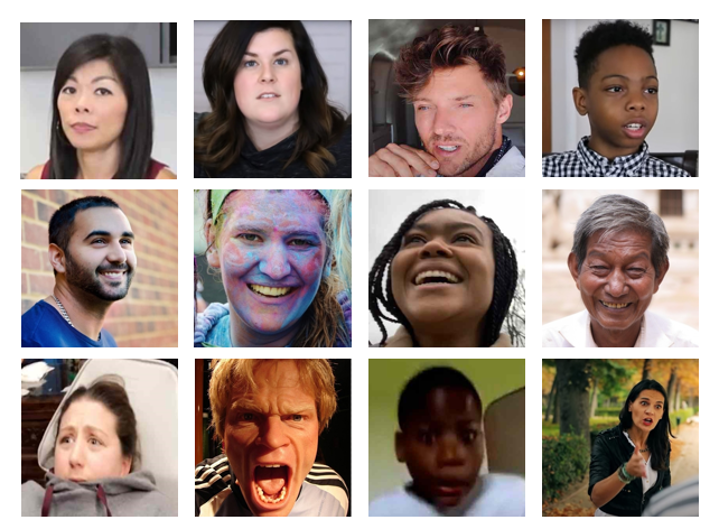
Images from the Wild Faces Database (Long, Peluso et al., 2023)
Facial Behaviour & Social Cognition
Understanding Human Social Cognition Using Naturalistic Facial Behaviour
Faces are mesmerising sources of social information; from facial movements we are able to recognise an incredible variety of signals, combining them in context to infer what someone is thinking or feeling. Yet our current understanding has been shaped by the use of posed images of emotional expressions, curated to represent discrete, universally-recognised categories such as 'happy', 'sad', and 'angry'.
My colleagues and I suggest this approach overly-simplifies the rich and complex variation in face behaviour we experience outside the lab — indeed, there may be more salient emotional information in non-posed naturalistic faces (Peluso et al., 2025, Emotion) which is perceived as more genuine (Long, Peluso et al., 2023, Nature Scientific Reports).
To further understand how real-world faces communicate social information, this project seeks to identify the key characteristics underlying our mental representations of both static and dynamic 'wild' facial expressions, by combining non-biased, data-driven behavioural tasks with theory-derived representational properties and computational models (such as representational similarity analysis and multidimensional scaling).
Together, we seek to develop more ecologically valid methods to bridge what we know about faces in the lab with how we perceive faces in the real world.